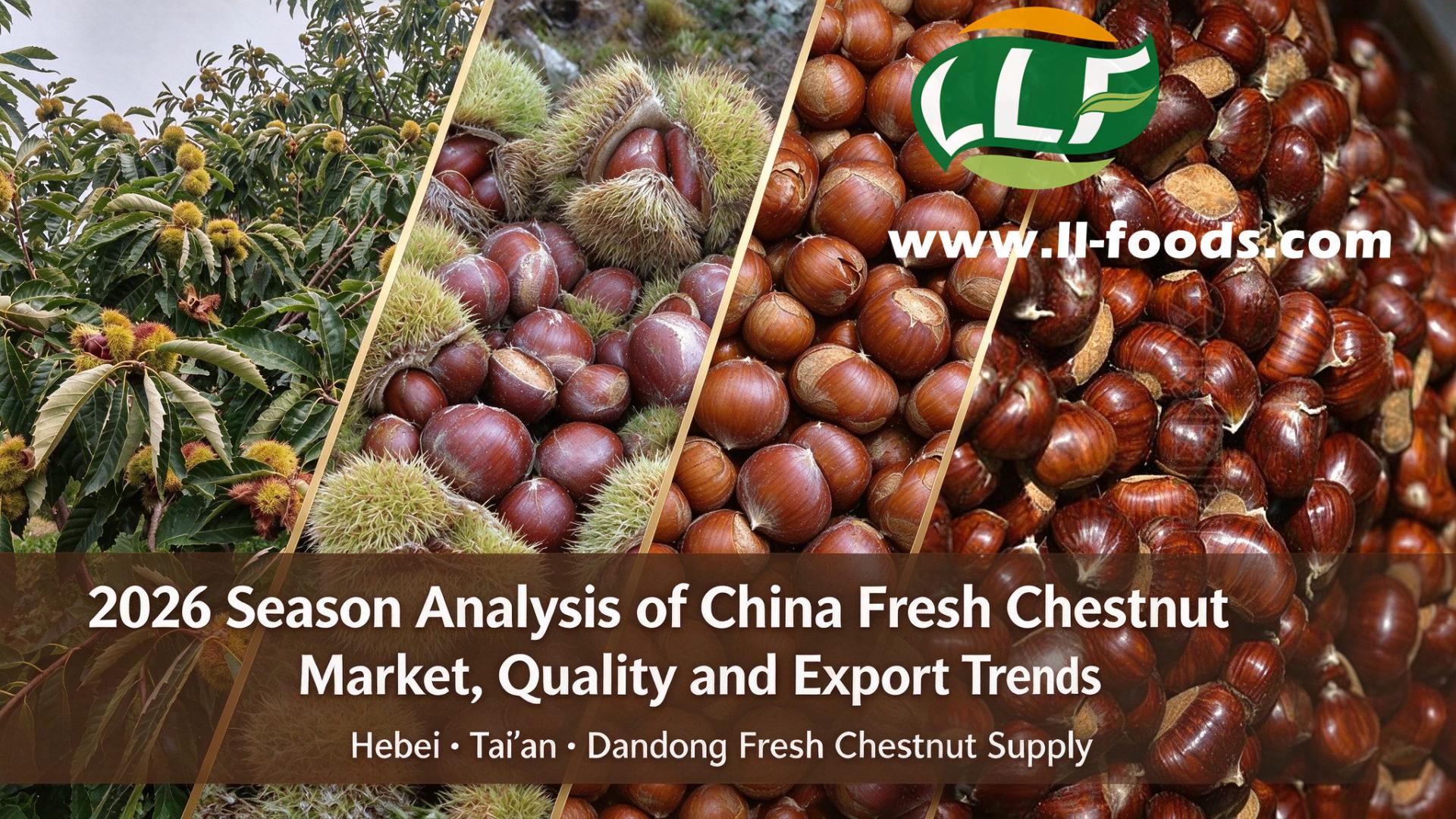
Fresh Chinese chestnuts of the 2026 new harvest season have been launched successively from core producing regions starting in September. Large-scale harvesting kicks off in three major chestnut producing areas: Hebei, Tai’an of Shandong and Dandong of Liaoning. The purchasing price of raw materials features a high opening at the early marketing stage, followed by a decline after mass harvesting, alongside a notable widening of price gaps between different quality grades. Chestnuts from different origins have respective advantages in nut size, sweetness and processing suitability. Export order structures and packaging solutions keep evolving to meet demands of target markets, offering diversified supply options for global bakery, fresh wholesale and food processing buyers.
I. Quality and Raw Material Market of the Three Core Producing Regions in 2026 SeasonHebei Sweet Chestnut (Yanshan / Qianxi Chestnut) Hebei is a traditional premium chestnut producing base in China. Favourable weather conditions in 2026 yield evenly shaped nuts with golden flesh, well-balanced starch and sugar, and prominent waxy texture. It is highly suitable for roasting, sugar-roasted chestnuts and deep processing of chestnut kernels. This season sees a slight drop in overall output of the region, with high purchasing prices at the early launch of new chestnuts; raw material prices corrected after concentrated harvesting in mid-to-late September. Grade-A nuts free of wormholes and with low defective rates command obvious premiums. Raw materials of medium and small specifications enjoy active circulation, making it the dominant supply variety for high-end fresh markets in Japan and South Korea.
Tai’an Chestnut, Shandong Tai’an chestnut features thin shell, firm flesh, delicate sweet flavour, stable grain size and good storage resistance, suitable for fresh export and industrial processing. In 2026, pest and disease control in the producing area performed well, with a lower defective rate than previous years and stable overall quality. Raw purchasing prices fall between Hebei chestnut and Dandong chestnut. It maintains steady and continuous supply, and has long been the mainstream choice for fresh wholesale markets in the Middle East and Southeast Asia, widely used for supermarket retail and bakery raw materials.
Dandong Dajinhua Chestnut, Liaoning Dandong Dajinhua Chestnut is characterised by large-sized nuts, plump kernels, bright flesh colour, easy shell peeling and excellent sweetness, ideal for fresh retail and roasting processing. The harvesting schedule in Dandong was slightly delayed in 2026, with limited supply in the early stage and relatively high opening prices. Raw material prices gradually declined as shipments expanded in October. Premium large-size nuts carry significant premiums and are a popular procurement item for markets in Europe and Russia.
II. Core Export MarketsAsian markets (Japan, South Korea, Southeast Asia, UAE, Saudi Arabia) remain the largest demand markets for China’s fresh chestnuts. Demand continues to grow in Russia, EU, the UK and North Africa. Different markets impose differentiated requirements on chestnut specifications, surface blemishes and pesticide residue standards: Japan and South Korea require strict sorting with minimal defects; the Middle East and Russia prefer medium to large nuts; European buyers place bulk purchases for bakery and western cuisine ingredient processing.
Main Export Packaging Options (Customised per Client Requirements)Gunny Bag: 25kg per bag for bulk raw materials, suitable for wholesalers and processing factories, widely used for bulk orders to the Middle East and Russia.
PP Mesh Bag: 1kg / 5kg /10kg mesh bags with labels, for supermarket fresh retail, the preferred packaging for Israel, Kuwait, Iraq, Southeast Asia and supermarket channels.
Carton with inner PE fresh-keeping bag: 5kg and 10kg colour cartons for premium graded chestnuts, specially supplied to high-end fresh markets in Japan and South Korea.
Vacuum-packed chestnut kernels: Shelled quick-frozen chestnut kernels for bakery and pastry processing, targeting food manufacturers in Europe and America.
III. Market OutlookShort-term (Oct–Nov): New chestnuts are fully available from all producing regions with sufficient supply. Overall raw material prices will remain weak and volatile. After Frost’s Descent, chestnuts keep accumulating sugar and reach optimal taste. The overseas procurement peak arrives, pushing up demand for premium export-grade chestnuts and underpinning prices of high-quality chestnuts.
Medium and long-term (December to the first half of next year): Fresh chestnuts will enter cold storage for preservation. If inventory of premium nuts is consumed rapidly coupled with overseas holiday stocking demand, export quotations have chances to rebound from the year-end to Q1 of next year. However, substandard nuts with high inventory will remain under persistent price pressure.
IV. Additional Industry News SnippetsAutumn brings rich aroma of chestnuts. On September 21st, inside a chestnut processing enterprise in Qianxi County, Tangshan, Hebei, automated production lines run at high speed with seamless connections between feeding, filling, sterilisation and packaging procedures. At present, chestnut products in Qianxi include chestnut kernels, iced chestnuts, chestnut blossom facial masks and more. Its series of chestnut products are exported to Australia, Singapore, South Korea, Japan, Europe and America.
China is the world’s largest chestnut exporter, accounting for over 80% of global export volume. In 2025, China’s chestnut export value reached USD 81.609 million. Shandong, Hebei and Yunnan rank as the top three provincial exporters in China. Major export destinations include Thailand, Chinese Taiwan and Japan. Currently, exported products are dominated by raw fresh chestnuts, while deep-processed products take a relatively low share with room for higher added value. China boasts huge total chestnut output, yet exports only account for approximately 1.6% of total production, leaving massive potential for overseas market expansion.
HS Codes: Fresh chestnuts (in shell): 0802411000; Shelled chestnut kernels: 2008199100In the first seven months of 2026, the export value of fresh chestnuts stood at around USD 12.6 million, rising roughly 14% year-on-year. The Southeast Asian market achieved outstanding growth. Vietnam and Thailand are the top two destinations for fresh chestnuts, while Azerbaijan and Cambodia recorded remarkable growth. The market for processed chestnut kernels is dominated by Japan, which accounts for nearly 47% of processed chestnut kernel exports.
RCEP Benefits: With certificates of origin, chestnut products enjoy tariff reductions in Japan, South Korea and other countries, driving order growth.
Regional characteristics: Hebei chestnuts target high-end fresh markets of Japan and South Korea; Shandong chestnuts supply bulk markets in the Middle East and Southeast Asia; large-size Dandong chestnuts from Liaoning see continuously rising demand in bakery channels across Russia, the Middle East and Europe.