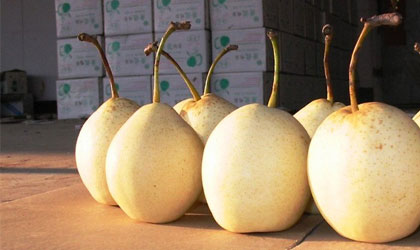
 Exports of Chinese pears to the Middle East have risen markedly, with a year-on-year increase of 62.51% in the first half of 2025.
Official export data shows that shipments of Chinese pears to the EU and the UK have maintained a steady growth trend, while exports to the Middle East have also climbed gradually. As the harvest season for new-crop fresh pears kicks off, Chinese fresh pear exporters need to explore new development paths amid fierce market competition to stabilize export volumes.
In recent years, China's pear exports to overseas markets have increased year after year. According to China's customs data, the total exports of Chinese fresh pears to EU countries and the UK in 2024 rose by 13.86% year-on-year compared with 2023; the overall export volume in the first half of 2025 saw a year-on-year uptick of 18.26% from the same period in 2024. The Middle East market has also delivered a standout performance: exports of Chinese fresh pears to the region grew by 3.69% year-on-year in 2024, and this year-on-year growth rate surged further to 62.51% in the first half of 2025.
Sales data for the first half of 2025 reveals a substantial year-on-year rise in China's fresh pear exports to the Middle East, which may emerge as a new opportunity for the industry's development. While there is a certain level of demand for Chinese pears in the EU and the UK, the overseas consumer market for Chinese pears still mainly relies on Asian immigrant communities. In particular, the preference for Chinese pears among ethnic Chinese consumers and those from East and Southeast Asia has driven the shelving and sales of the product in overseas retail channels. In addition, the upgraded and optimized cold chain transportation and packaging technologies have extended the shelf life of fresh pears, making overseas retailers and e-commerce platforms more willing to stock Chinese pear products.
At present, Crown pears are the primary variety of Chinese fresh pears for export, as they are more in line with the taste preferences of overseas consumers. Professional domestic fruit and vegetable export enterprises are basically able to ensure a stable year-round supply. Furthermore, through on-site inspections and market research overseas, domestic enterprises have developed and cultivated ten pear varieties with distinct flavors to meet the diverse taste demands of overseas markets.
The staggered ripening of different pear varieties has not only extended the supply cycle of Chinese fresh pears in the international market but also further enhanced the supply capacity to the EU and the UK. The sustained growth in export volumes also indicates that competition in the international market is becoming increasingly fierce. As the mass supply of new-crop Crown pears begins, Chinese fruit and vegetable export enterprises need to leverage high-quality customer service, stringent quality control and screening, and stable supply capacity to continuously enrich export varieties in line with market demand and expand their overseas business footprint. In the long run, the expansion of pear export varieties still depends on the acceptance of overseas consumers. This requires enterprises to create consumption scenarios that align with local cultures and enhance the international market awareness of Chinese pear products through continuous communication with consumers.
Source: China Fruit and Vegetable Industry Association